Come July, most pike fishermen are still throwing spinnerbaits over the same weed beds that produced in June. They're casting to empty water. The pike left three weeks ago. When the water hits 20°C, everything about pike behaviour changes, and if you don't change with it, you go home empty-handed.
Why 20°C Changes Everything
Pike are built for cold. Their ideal temperature range is 14°C to 18°C. Once the water pushes past 20°C, their metabolism still works fine but their behaviour flips completely. They stop chasing. They start waiting.
A spring pike will swim ten feet to crush a lure. A summer pike wants that lure within a foot of its nose. That's why you need to put your bait exactly on the edge, not somewhere near it.
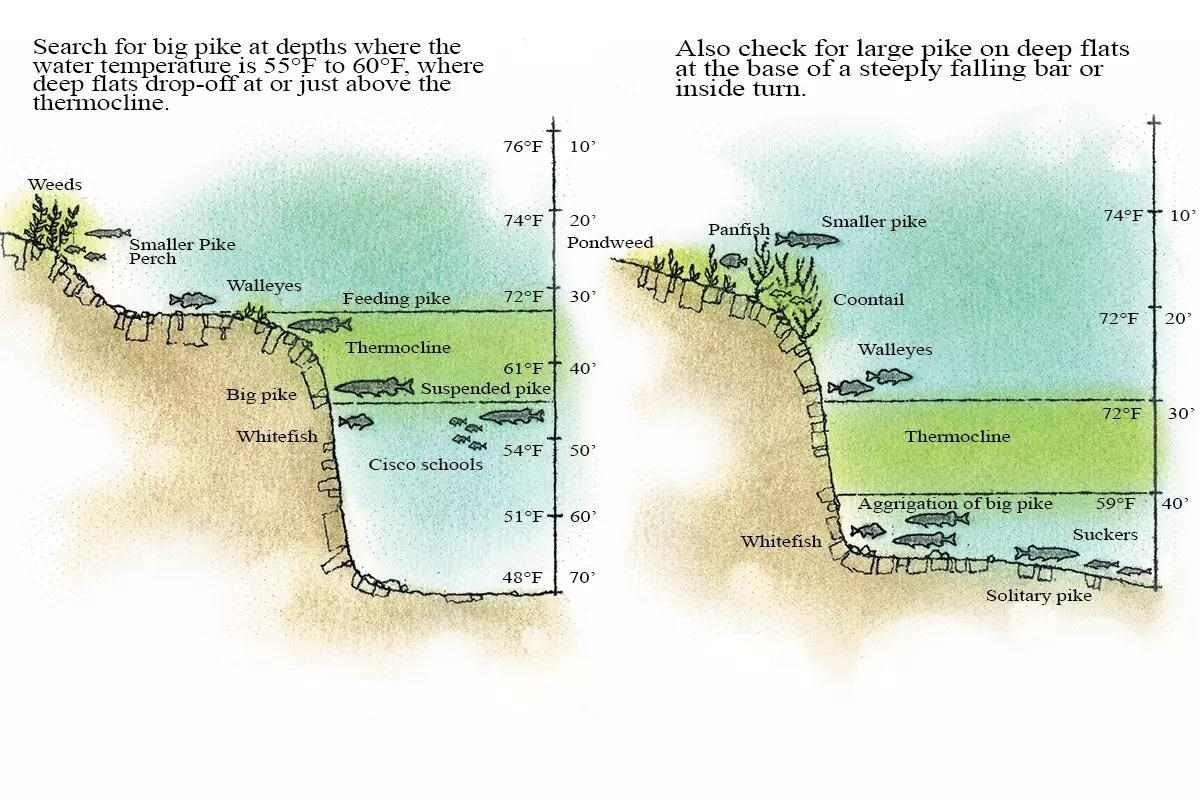
Pike slide off the flats and park themselves on the first sharp drop they can find, usually right where the weeds end and the deep water begins. Find that transition and you find the fish.
Weed Edges Are Summer Gold
The weed edge isn't a line, it's a wall. On Montreal's lakes, weed beds grow out from shore until they hit deeper water. On Lac Saint-Louis, the weeds often stop at eight to ten feet. The exact depth doesn't matter; what matters is the transition.
Pike sit right on that transition, bellies in the deep water, heads in the weeds. They watch both zones at once. A perch wanders out of the weeds? Lunch. A cisco drifts over from deep water? Lunch.
The key is presentation angle:
- Cast parallel to the weed edge, not across it
- If you cast from deep to shallow, you pull the lure away from the edge too fast
- If you cast from shallow to deep, you drag it over the weeds and foul
How to work it: Position your boat in eight feet of water, right over the weed tops. Cast parallel to shore, keeping the lure in that transition zone. Reel slow. A paddle tail swimbait or a large spinnerbait on a slow-roll retrieve. The pike won't chase, they'll just open their mouths.
The Drop-Off Pattern
Not every lake has weeds that form a clean edge. Some have rocky drop-offs, some have sandbars that plunge into deep basins. Same principle, different presentation.
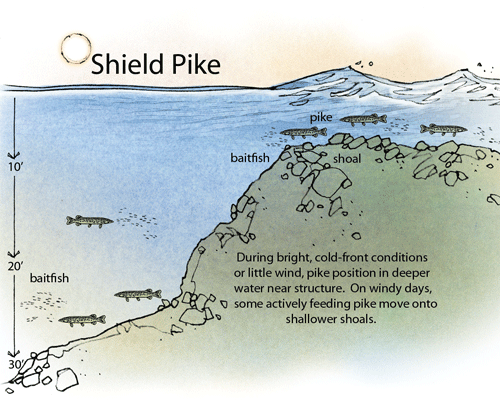
On a rocky drop-off, pike hold right at the break. Not on top. Not at the bottom. At the break. They use the deeper water as a highway to move along the structure and the shallow rocks as a place to pin baitfish.
The tell is the bait. If you mark baitfish suspended at fifteen feet over twenty feet of water, pike are usually hanging right below them or right at the nearest structure break. Find the bait. Find the break. Find the pike.
Lac Saint-Pierre is a perfect example. It's shallow across most of the lake, but old river channels cut through dropping to fifteen or eighteen feet with steep sides. July and August, pike stack on those channel edges like logs. You can catch them all day dragging a jig along the drop, but you won't touch a thing ten feet away from it.
Boat Positioning Is Half the Fight
You can't fish a weed edge from twenty yards out, the angles don't work, and your lure spends too much time in the wrong zone. Get close. Close enough that you could almost touch the weeds with your rod tip, then back off just enough to cast parallel without snagging every other throw.
On Montreal's smaller lakes like Lac des Deux Montagnes, that might mean putting the trolling motor on its lowest setting and creeping along the edge for an hour. The guy who drifts through the middle of the bay catches nothing. The guy who hugs the weed line catches pike.
Lure Choices for Summer Pike
Slow. Everything slow.
Spring pike want a fast-moving spinnerbait or a burning crankbait. Summer pike want a large soft plastic on a jig head, dragged along the bottom.
- Paddle tail swimbait, 6 inch, perch or white colour, slow roll along the break
- Curly tail grub on a jig head, ½ to ¾ oz, white or chartreuse; cast to the edge, let it sink, drag back one foot at a time
- Big tube bait, effective on rocky drop-offs
- Deep-diving crankbait, for midday when pike push to 15–18 ft; must tick bottom
When you feel the drop on the retrieve, pause. That's where the pike are. A lot of guys refuse to fish this slow, they get bored and go back to burning spinnerbaits over the top and catching nothing. Let them.
Timing on Summer Lakes
Morning and evening still work. But summer pike also bite in the middle of the day if you're fishing deep enough.
On a bright July afternoon, pike on Lac des Deux Montagnes slide down the drop-off to fifteen or eighteen feet and sit right on bottom. You won't see them, your depth finder might not even mark them if they're hugging tight to the rocks. But they're there. Go heavier, a three-quarter ounce jig or a deep-diving crankbait. Make contact with the bottom. If you're not dragging through rocks or weeds, you're too high.
One Warning About Montreal Lakes
The pike pressure on waters like Lac Saint-Louis and Lac des Deux Montagnes is real. Those fish have seen every lure in every colour. Keep it simple, white jig, perch-patterned soft plastic. Don't throw the weird purple thing you bought online.
The biggest pike of last summer came from a weed edge on Lac Saint-Louis in mid-July. Ninety degrees outside, bright sun. A half-ounce white grub dragged so slow it was almost boring. The fish hit five feet from the boat. Not a spectacular strike, just a heavy pull and a lot of head shakes. Thirty-six inches. Fat. Healthy. Sitting right on the break exactly where the books say.
The edge is where they live. You just have to slow down enough to find them.

Montreal's freshwater fishing community, sharing techniques, spots, and stories from the water since 2020.